For six months, I built a medium-sized, complex application almost entirely with AI assistance – using Claude Opus 4.8 and 5, embedded in a Secure SDLC. Scope: client application, client website, and AWS infrastructure including CloudFront, WAF, load balancers, APIs, and PostgreSQL → AWS RDS as a Managed Database Service.
The Setup
No model was simply allowed to “do its thing”. Defined roles, skills, mandatory rule sets – and a required security gate for every pull request: an independent review by a model from a different provider, ChatGPT Codex, checked against
→ OWASP Top 10 and OWASP API Security Top 10 → OWASP ASVS as a reference for security requirements and verification → authentication, authorization, session handling, security logging, error handling → IDOR, CSRF, XSS, SSRF, token replay, enumeration, rate-limit bypass
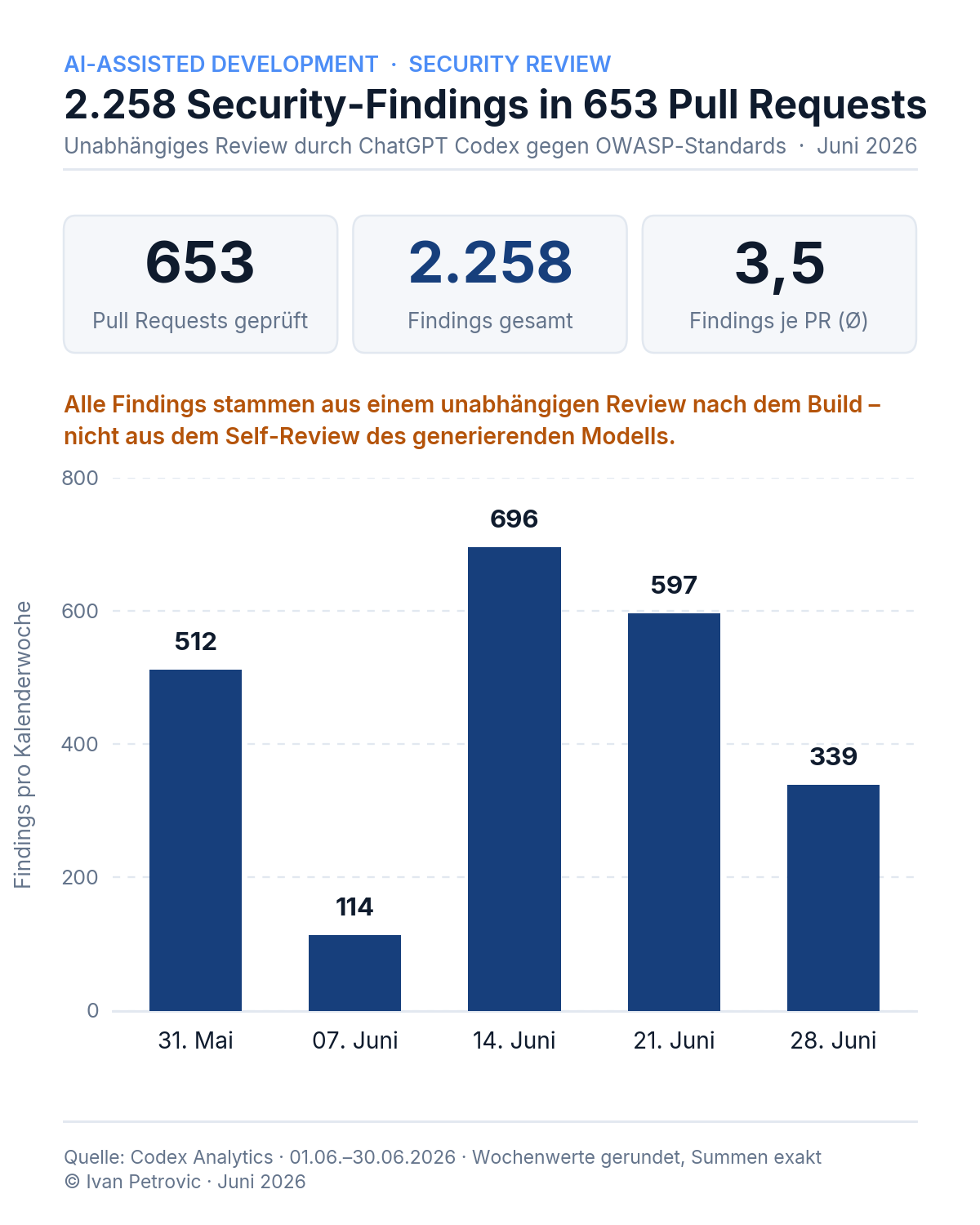
The result (June 2026): 653 reviewed pull requests · 2,258 findings · Ø 3.5 per PR
Peak week: 696 findings, including 120 P1 (high) and 576 P2 (medium).
Three Observations
- The generating model does not reliably identify its own vulnerabilities. A significant share of these findings would never have been detected without an independent second review.
- Fixes introduce new vulnerabilities. Addressing reported findings regularly resulted in new ones – without regression reviews, these make it into production.
- Without guardrails, an autonomous development process does not meet common security standards. Speed is not an indicator of quality.
My Most Important Learning: AI Is the Enabler of the Security Process.
The same models that generate insecure code can support the security process – once they are used against each other and evaluated against a defined set of rules. The risk can be turned into an opportunity: compliance processes can be supported while the code is being written, and a secure development process can be implemented largely autonomously. There is no such thing as a perfect result – but a highly cost-effective, secure, and fast one is possible.
For CISOs and Compliance Professionals
AI-generated code is not reviewed code. Organizations that allow AI-assisted development need an enforceable gate in the merge process, traceability against a recognized standard, and a measurable history of findings. This is exactly the kind of evidence required in an audit.
For Developers, Especially Juniors
Do not rely on either the model’s self-review or its implementation of security requirements. The code may compile and look clean – and still be insecure.
My View
Using AI-driven processes to enable security is an opportunity to relieve pressure on security teams and developers facing resource constraints. Now is the time to bring the same speed to security.